

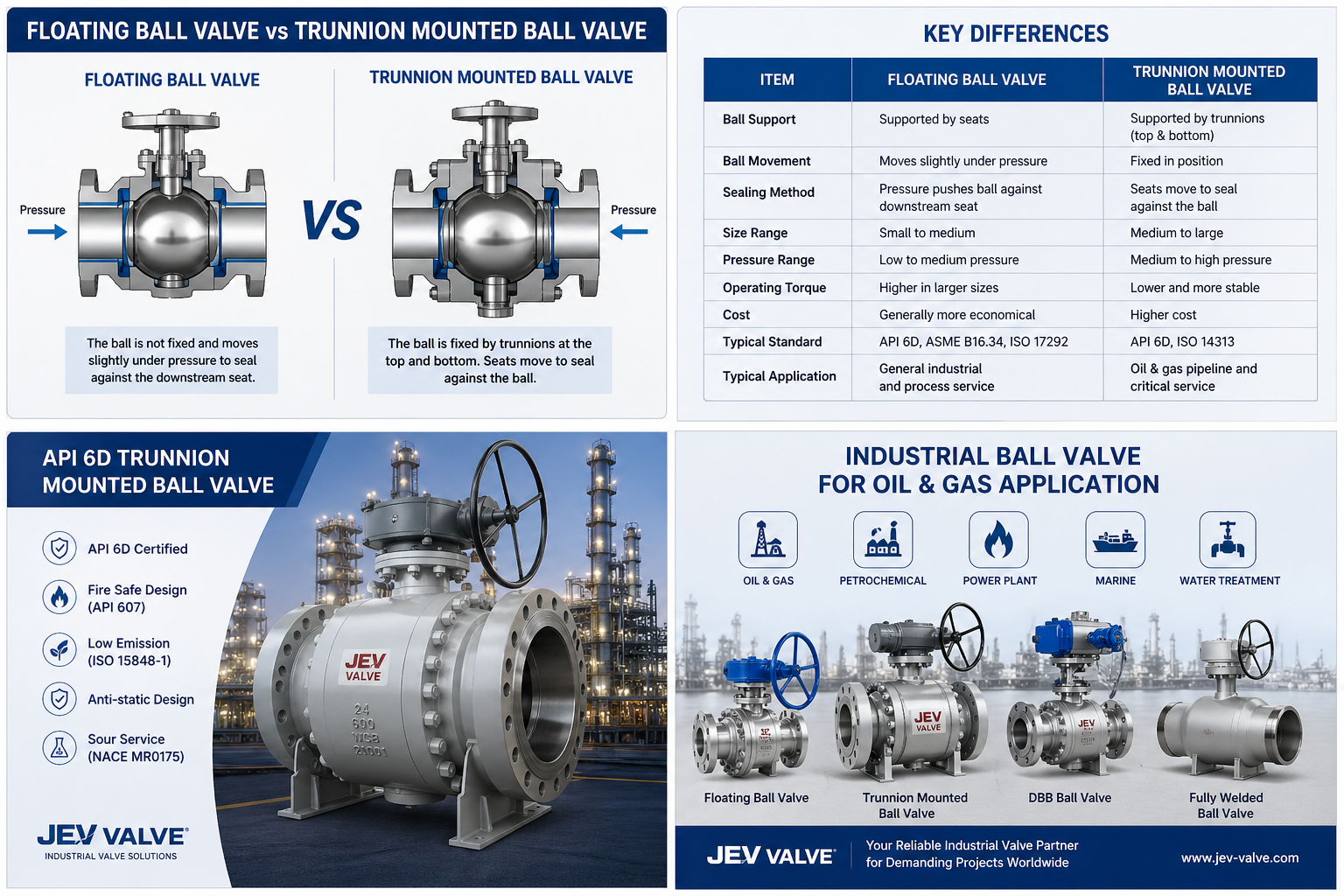
Quick Summary: Floating ball valves and trunnion mounted ball valves are two common ball valve designs widely used in oil and gas, petrochemical, power, and industrial pipeline systems. This article explains their main differences in structure, sealing method, pressure range, operating torque, and typical applications.
What Is a Floating Ball Valve?
A floating ball valve uses a ball that is held in position mainly by the valve seats. The ball can move slightly in the direction of the flow when pressure is applied. This movement helps the ball press tightly against the downstream seat, creating a reliable seal.
Floating ball valves are commonly used for small and medium sizes, especially in low to medium pressure applications.
Typical features include:
- Simple structure
- Compact design
- Good shut-off performance
- Lower manufacturing cost
- Easy maintenance
- Suitable for manual operation in smaller sizes
Floating ball valves are widely used in utility lines, process pipelines, chemical plants, oil and gas systems, and general industrial services.
What Is a Trunnion Mounted Ball Valve?
A trunnion mounted ball valve has the ball fixed and supported by trunnions at the top and bottom. The ball does not float with pressure. Instead, the seats move toward the ball to achieve sealing.
This design is especially suitable for large-size and high-pressure pipeline applications. Because the ball is mechanically supported, the operating torque is much lower compared with a floating ball valve of similar size and pressure class.
Typical features include:
- Fixed ball structure
- Lower operating torque
- Suitable for large sizes
- Suitable for high-pressure service
- Better stability under pipeline pressure
- Easier actuator selection for large valves
- Commonly designed according to API 6D
Trunnion mounted ball valves are frequently used in oil and gas transmission pipelines, gas processing plants, refineries, petrochemical units, LNG facilities, and critical shutdown applications.
Key Technical Differences
| Item | Floating Ball Valve | Trunnion Mounted Ball Valve |
|---|---|---|
| Ball Support | Ball is supported by seats | Ball is supported by upper and lower trunnions |
| Ball Movement | Ball can move slightly under pressure | Ball is fixed in position |
| Sealing Method | Pressure pushes the ball against the downstream seat | Spring-loaded or pressure-assisted seats seal against the ball |
| Common Size Range | Small to medium sizes | Medium to large sizes |
| Pressure Range | Low to medium pressure | Medium to high pressure |
| Operating Torque | Higher in larger sizes | Lower and more stable |
| Cost Level | Generally more economical | Higher cost but better for severe service |
| Typical Standard | API 6D, ASME B16.34, ISO 17292 | API 6D, ISO 14313 |
| Typical Application | General industrial and process service | Oil and gas pipeline and critical service |
How to Choose the Right Ball Valve Type
The selection between floating ball valve and trunnion mounted ball valve should be based on project requirements, including valve size, pressure class, fluid medium, operation method, and service criticality.
A floating ball valve is usually suitable when:
- The valve size is relatively small
- The pressure class is not extremely high
- Manual operation is acceptable
- The project requires a cost-effective solution
- The service condition is general industrial use
A trunnion mounted ball valve is usually preferred when:
- The valve size is large
- The pressure class is high
- The pipeline medium is oil, gas, or critical fluid
- Low operating torque is required
- Gearbox, pneumatic actuator, or electric actuator operation is required
- DBB, DIB, anti-static, fire-safe, or emergency sealing features are required
For oil and gas projects, trunnion mounted ball valves are often specified for main pipeline isolation and critical shut-off service.
Typical Standards for Ball Valves
Depending on the project specification, ball valves may be designed and manufactured according to different international standards.
Common standards include:
- API 6D / ISO 14313: Pipeline valves for oil and gas applications
- ASME B16.34: Pressure-temperature rating and valve design requirements
- ISO 17292: Metal ball valves for petroleum, petrochemical, and allied industries
- API 607 / API 6FA: Fire-safe test requirements
- ISO 15848-1: Fugitive emission test requirements
- NACE MR0175 / ISO 15156: Materials requirements for sour service
For oil and gas projects, API 6D ball valves are commonly required, especially for pipeline and critical service applications.
Why Proper Ball Valve Selection Matters
Incorrect valve selection may lead to high operating torque, sealing failure, actuator oversizing, leakage risk, or unnecessary project cost.
For example, using a floating ball valve for a large-size high-pressure pipeline may result in very high operating torque and difficult operation. On the other hand, using a trunnion mounted ball valve for a small low-pressure utility line may increase cost unnecessarily.
A professional valve manufacturer should evaluate the full working condition before recommending the valve type.
Key factors include:
- Valve size and pressure class
- Fluid type and service condition
- Temperature range
- End connection
- Operation method
- Fire-safe requirement
- Fugitive emission requirement
- Sour service requirement
- Project specification and end-user approval requirements
JEV Valve Ball Valve Manufacturing Capability
JEV Valve supplies both floating ball valves and trunnion mounted ball valves for oil and gas, petrochemical, power, marine, and industrial pipeline applications.
Our ball valve product range covers:
- Floating ball valve
- Trunnion mounted ball valve
- Side entry ball valve
- Top entry ball valve
- Fully welded ball valve
- DBB ball valve
- Metal seated ball valve
- Soft seated ball valve
- Manual, gear-operated, pneumatic, and electric actuated ball valves
JEV Valve can support project requirements according to API 6D, ASME B16.34, ISO 17292, API 607, ISO 15848-1, NACE MR0175 / ISO 15156, and other international standards.
With integrated manufacturing, machining, assembly, testing, and quality control capabilities, JEV Valve provides reliable ball valve solutions for demanding industrial and energy projects.
Conclusion
Floating ball valves and trunnion mounted ball valves serve different application needs. Floating ball valves are simple, compact, and cost-effective for small and medium-size applications, while trunnion mounted ball valves are more suitable for large-size, high-pressure, and critical oil and gas pipeline services.
For engineering projects, the right selection should be based on the complete technical specification rather than only valve size or price. Working with an experienced valve manufacturer helps ensure correct valve design, reliable sealing performance, and long-term operating safety.


